“Anishinaabe and Métis Territory?”: An Ice Breaker

The following is an open letter that was sent to the Dean of the Bora Laskin Faculty of Law, and the Chair of Truth and Reconciliation, Lakehead University, on November 10, 2016:

Boozhoo,

Once upon a time, explorers showed up in Anishinaabe aki and claimed it as their own. This was just part of how things were done then – if one group of explorers found Indigenous lands before another group, they assumed ownership to that land and named it. This method could be said to be the early beginnings of how Canada became a country. For Anishinaabeg, however, such naming and claiming is part of a larger process of ignoring Anishinaabeg peoples’ inherent relationship and responsibilities with the lands, waters, and beings we’ve lived with for thousands of years. Today, the Robinson-Superior Treaty and Robinson-Huron Treaty of 1850 and Treaty 3 (1873) may be utilized to push back on unilateral claiming. These treaties remain expressions of Anishinaabe territorial sovereignty today.

Fast forward a few hundred years, and the issue of naming as claiming remains in effect. But things are more complicated now; generations of identity regulation by the federal government have produced divisions between Indigenous peoples, awarding recognition to some and none to others. This politics of federal recognition is one way in which Canada lays claims to land: recognizing the territorial claims of those who find their self-governance authority within what the settler state will allow is much safer than recognizing the sovereignty of Indigenous nations that exist outside its purview. It is with this history in mind that we as Anishinaabeg and Indigenous scholars wish to discuss a recent claim to Anishinaabe territory.

In October 2016, Lakehead University posted to its website an employment opportunity for professorship in its Bora Laskin Faculty of Law. In part, that posting read: “Given the Faculty’s presence in Anishinaabe and Métis territory, preference will be given to qualified candidates with research and teaching expertise in either Anishinaabe law or Métis law or both.” While we are excited to see the establishment of a law program in Anishinaabe aki that centres Indigenous legal systems, as Anishinaabe citizens and scholars we aren’t sure how to interpret Lakehead’s claim that Thunder Bay, Ontario and surrounding areas are Anishinaabe and Métis territory. In truth, we were somewhat surprised. Within our respective families, communities, and research, we had not come across such a claim until now. We would therefore like to discuss this claim openly.

Before we share our thoughts, we want to acknowledge and recognize that Métis have and continue to experience colonial violence from Canadians and other Indigenous nations alike. In addition to land theft in the West and other forms of violence, this has also taken the form of questioning the very existence of Métis. We do not want to perpetuate such violence. We also want to be transparent that we have professional, personal and familial relationships with Métis individuals and families that we wish to uphold.

We also recognize that Métis identity is currently being debated by Métis themselves. Such debates put definitions of “Métis-as-mixed” in contrast with Métis as political peoplehood. While many Métis live within many different treaty areas including within Robinson Treaty lands and in Treaty 3 territory, we recognize the Métis as Indigenous peoples who came to define themselves as Métis through the establishment of a unique political consciousness in the Red River area and points west. Conversely, we agree with Métis scholars who argue that framing Métis as “mixed” effects all Indigenous nations in Canada because such approaches centre biological essentialism at the expense of the political consciousness and sovereignty that underwrites Indigenous peoples as nations.

These issues take on further complexity in northwestern Ontario for a number of reasons. One, the Métis Nation of Ontario (MNO) is engaging in agreements with natural resource corporations. Two, historically, many Anishinaabeg were misrecognized as “halfbreeds” by the Crown and its representatives. We understand that these MNO agreements with the settler government are being addressed by other Anishinaabeg and Métis so we will not address this here. Regarding misrecognition, this was a gendered and racialized approach to defining identity by prioritizing biological mixedness above Anishinaabe citizenship orders. For example, the Métis Nation of Ontario’s website states, “Prior to Canada’s crystallization as a nation, a new Aboriginal people emerged out of the relations of Indian women and European men.” We’d like to draw attention to how this implies Anishinaabe women were reimagined as being responsible for creating a new nation at the expense of their Anishinaabe citizenship, a reworking that both legitimizes Métis-as-mixed nationhood claims while removing women from being Anishinaabeg. Such constructions of Métis nationhood create complexities in understanding historical northern Ontario politics: we are aware that, in the lead up to the signing of the Robinson Treaties of 1850, some halfbreeds at Sault Ste. Marie claimed a separateness from Anishinaabeg and the nascent settler societies that would become Canada. We are also aware of the Halfbreed Adhesion to Treaty 3 (in 1874). Yet we would like to draw attention to how many “halfbreeds” were considered Anishinaabe through matrilineal Anishinaabe kinship and clan systems despite having some European ancestry. Indeed the issue of their “white blood” was not problematic until treaty negotiations when settler colonial governments needed to categorize and quantify “her Majesty’s Indians.” In fact, among Anishinaabeg, often halfbreeds were distinguished from Métis through different identifiers like “Red River Indians.” This is not to say that said halfbreed communities were not Indigenous, nor is it to say Métis did not travel back and forth from the Red River to these locales while using kinship governance to do so. However, we concur with Métis scholars when they suggest that said communities may or may not have thought of themselves in ways separate from the Métis of the west. Clearly, working through northern Ontario history requires great care in order to avoid reproducing settler colonial constructions of Indigeneity. Though committed to this ethic, we nonetheless struggle to do it right.

Getting back to the job ad, we are concerned that the phrase “Anishinaabe and Métis territory” rhetorically and powerfully names and claims Anishinaabe territory as Métis territory. First, we worry that the claim of Métis territory is a false claim. Halfbreeds were no doubt present at Fort William since the 19th century, but so were settler colonialists that sought to eliminate Anishinaabe presence through gendered and racialized misrecognition. Without a clear definition of what is “Métis territory” in this ad, we worry Lakehead may be reproducing a Métis-as-mixed-based claim to territoriality.

Further, in response to several emails inquiring into the meaning of this claim of “Métis territory,” on November 8, 2016 Dean Angelique EagleWoman responded. She suggested the Métis Nation of Ontario be contacted to gain an understanding of Métis presence in the Thunder Bay area. We were also made aware of the LU Faculty of Law’s 2013 protocol agreement, signed in part by the Métis Nation of Ontario as well as the Anishinabek Nation (Union of Ontario Indians), Grand Council Treaty #3, and the Nishnawbe Aski Nation. Unfortunately, this response does not provide any clarification to the query into the meaning of “Métis territory.” First, the job advertisement claims territory, not presence. Second, ensconcing the relationship between the Bora Laskin Faculty of Law and the MNO in the internal architecture of “Advisory Committees” and “Protocol Agreements” also fails to elucidate the meanings of “Métis territory” that are being claimed in this job ad. The long silence between the emails sent and the response, paired with an opaque response that was eventually given on November 8th, which essentially sends Anishinaabeg down a garden path, is disappointing. In an era of Truth and Reconciliation, this way of responding to Anishinaabeg is also curious. Given the outcome of these initial exchanges, we pursue another angle. Here, we wish to attend to Métis agency–or rather, MNO agency–in advancing their interests in Anishinaabe homeland, lands, and territory. We also prompt Lakehead to reflect on its agency and interests in supporting the trajectory being taken by this organization on behalf of Métis.

Following this trajectory that queries Métis agency, we worry that this naming upholds a politics of recognition whereby Anishinaabe lands and waters are claimed by Métis and organizations without the express sanction of Anishinaabeg themselves. As we see it, recognition from Canadian law and jurisprudence is not enough to claim Métis title within Anishinaabe territory. Rather, we feel that if Métis want to claim land within Anishinaabe territory, and use settler institutions to advance their agenda, they would need to first have those conversations and agreements with Anishinaabeg. This would occur outside of Canadian law and Canadian institutions. We are unaware of any such serious and important conversations being had to date.

In thinking about Lakehead’s claim that it sits on Anishinaabe and Métis territory, we have come to see other potential dangers emerging more broadly within Canada. We see potential for the state to push its brand of “reconciliation” through universities, sometimes using Indigenous individuals to do so, to undermine Indigenous nationhood. Lakehead’s claim to sit within Anishinaabe and Métis territory acts as a microcosm in which we can see how the state uses its power to recognize forms of Indigenous nationhood that are amenable to its distorted version of sovereignty, namely “self-government.” Through recognizing self-government of Indigenous nations where such recognition is based on Canadian liberal multiculturalist approaches to Indigeneity–as opposed to decolonization–the state can work to hijack nationhood claims. Drawing on the Lakehead claim as an example, through recognizing Métis claims to Anishinaabe territory, the state and individuals within the university advancing its agenda, can erase Anishinaabe territorial sovereignty under a narrative of Canadian aboriginal and multicultural politics. In doing so, Canadian multiculturalism is positioned as timeless and universal. Anishinaabe sovereignty is eroded in this scenario.

For this reason, we wish to centre Indigenous political and legal orders in territorial claims as well as in relationships between Indigenous peoples and the state, and amongst Indigenous nations. It is not enough to rely on recognition from the Canadian state to make claims to another peoples’ territory. To be just in a decolonizing sense, claiming territory must be done through Indigenous nation-to-Indigenous nation relationships and agreements. The creation and use of wampum belts to document and practice relationships between Indigenous Nations is just one example. Particular to our situation, we have a responsibility to centre Anishinaabe law within all Anishinaabe territory. We therefore have a responsibility to centre Anishinaabe law within Métis-Anishinaabe territory claims, and this must trump any claims made through Métis-Canada/Ontario relationships. Moreover, in centring Anishinaabe law within a decolonizing context, we have a responsibility to centre the experiences, knowledges and voices or Nokomisag (grandmothers), Anishinabekwewag (women), and two-spirited peoples.

In closing, we would request Lakehead University change its job ad with the above points in mind, and, accordingly, review any other of its statements where Anishinaabe territory is discussed. Perhaps, as an example, the job ad could be rephrased to state “….situated in Anishinaabeg territory, specifically within Treaty 3, the Robinson-Superior Treaty area, and the Williams Treaty area of the Anishinaabeg and Canada. Through kinship with Anishinaabeg, this territory is also home to many Métis.” We also request discussion with Lakehead University and other universities located within Anishinaabe territories about moving forward in constructing shared understandings about where we live, work, play, and learn. Finally, we urge our Anishinabe relatives–our grassroots leaders in our communities and our leaders through traditional government and political/territorial organization–take notice of what has taken place, and voice any of your concerns or ideas in regards to how territory is claimed in instances such as this.

minaademowin,

Makwa dodem
Waaseyaa’sin Christine Sy
Lac Seul First Nation member
Ph.D Candidate, Indigenous Studies (Trent University)
Lecturer, Gender Studies (University of Victoria)
giizismoon@hotmail.com

Waase dodem
Damien Lee – Zoongde
Fort William First Nation citizen
Ph.D Candidate, Native Studies (University of Manitoba)
Assistant Professor, Indigenous Studies (University of Saskatchewan)
connectwithdamien@gmail.com

Makwa nin dodem
Anang Onimiwin nnindishnikaz gaye Dr. Celeste Pedri-Spade, PhD (University of Victoria)
Lac des Mille Lacs First Nation member
Assistant Professor, School of Northern and Community Studies (Laurentian University)
cvpedri@gmail.com

Helen Pelletier
Fort William First Nation member
hdpellet@lakeheadu.ca

Tannis Kastern
Fort William First Nation member
Lakehead University Student Union
Director & Member of Lakehead University Native Student Association/National Aboriginal Caucus (CFS)

Stephanie MacLaurin
Fort William First Nation
Master of Arts Candidate, Indigenous Governance (University of Victoria)
smaclaur@lakeheadu.ca

Kingfisher Dodem
Geraldine King
Kiashke Zaaging Anishinaabek member
Ph.D Student, Queens University

Dennis McPherson
B.A., H.B.S.W., LL.B., H.B.A., LL.M.
Couchiching First Nation
Associate Professor
Department of Indigenous Learning
Lakehead University
dmcphers@lakeheadu.ca

Paul Chartrand, I.P.C.
B.A., LL.B.(Hons), LL.M.
St. Laurent, MB

-30-
When is it ok to be Racist?

By Jana-Rae Yerxa and Damien Lee

As we woke up yesterday morning, we read a piece on CBC News Thunder Bay about a complaint against Thunder Bay Police arising in the context of cross-cultural sensitivity training. The training was a part of the Walk a Mile Film Project, a partnership between the City of Thunder Bay and Thunderstone Pictures. In this training program which has become mandatory for City of Thunder Bay employees, race and Indigeneity are to be talked about as a means to promote understanding about Indigenous peoples for Canadians. However, as was clear in the news article, such a goal was allegedly undermined by the actions of a few cops.

Since Walk a Mile was “designed to encourage frank conversations in our community about the reality of life for [Indigenous] Peoples both here and across Canada,” we would like to add another layer of context that has been missing from the narrative up to this point.

While reading the article, it was clear to us that the complaint made against police was more than just about a “few bad apples.” Rather, it speaks to a system of power that upholds whiteness over Indigenous peoples, a symptom of colonial relations. No doubt it is a challenge to put together training that aims to address deep rooted issues like racism towards Indigenous Peoples. Miigwech to Thunderstone Pictures and the City of Thunder Bay for taking on such a challenging endeavor.

However, one of the main issues that does not get talked about enough in Thunder Bay is in identifying the approach taken when educating and creating space for such discussions. Approach matters because it determines what people walk away with and how conversations unfold. It is troubling when the approach taken, specifically in regards to race relations, is to educate white people about the “other” where the focus is on educating settler folks about an ‘Aboriginal experience,’ about ‘Aboriginal people’ and ‘Aboriginal history,’ instead of pointing the lens at settler colonialism and whiteness, both of which are root causes of the racial violence that Indigenous peoples experience. The approach of educating people who occupy dominant positions in this society about the “other” is harmful because it presents a guise of meaningful work, when the work needed — dismantling settler colonialism and ending settler colonial violence — is not actually being done.

With Walk a Mile in particular, the challenges are multiple from the beginning due to the partnership with the City of Thunder Bay. The issue of power must be highlighted here because of the structural power the City of Thunder Bay holds at the expense of Indigenous presence and how this power can be used and/or abused. By this, we mean that Walk a Mile is designed to speak to power – white power – in spaces where potentially those with the most power can make fun of Indigenous struggles without examining their own complicity with colonial violence. When this happens, it is not anti-colonialism or anti-racism, but a redeployment of violence through knowing the “other.”

Another important factor for us to consider when partnering cross culturally to address “race relations,” when structural power imbalances exist, are accountability measures. So in this instance, what accountability measures are in place, if any, to the Indigenous community? Accountability measures are crucial to ensuring that training, developed in partnership with Indigenous peoples, cannot be used as a ‘check mark’ by mainstream institutions. It would prevent the City from saying, “Look at what we are doing here to address racism,” when in reality the training may be not as successful as it is presented to be. It is also extremely problematic if Indigenous peoples are not the determiners of whether the training is achieving what it was intended to achieve.

In response to the Walk a Mile facilitator’s complaint, Thunder Bay city clerk John Hannam dismissed the alleged racism by stating police laughter during the training was “misinterpreted,” that it was part of a “side bar conversation,” and that the training “happened during a week when the attack on police in the United States and six or seven officers were murdered so there may have been some heightened sensitivity over that.” However, Hannam’s apologist response to these allegations is a part of the very problem we wish to shed light on. His response is a perfect example of what Sara Ahmed talks about in regards to evidence where racism is “denied because it is seen as a fault of perception…you perceive wrongly when you perceive wrong.” While the filmmaker behind Walk a Mile is calling for a public review of the city’s use of her work, it is also important to ask the question whether such a partnership with the City can be one that is accountable, anti-colonial or ethical considering the power relations we have spoken of here.

The complaint raised by the Walk a Mile facilitator has created an opportunity for us all to critically reflect how we contextualize significant matters, such as racism, that impact Indigenous humanity. In a city where the families of six dead Indigenous children called for police racism to be included in the scope of an inquest, and in a country where people are demanding police racism be analyzed as part of the Missing and Murdered Indigenous Women, Girls and 2 Spirit Inquiry, such allegations ask us to connect the dots: Indigenous peoples want the police investigated for anti-Indigenous racism. If anything, yesterday’s CBC story only demonstrates that such analysis is needed and leaves us with pondering the question, when is it okay to be racist?

Results of the “Grand Trunk Pacific Settlement Survey”

Introduction
In April 2016, it was announced that Fort William First Nation (FWFN) received a settlement offer from Canada regarding its Grand Trunk Pacific Settlement land claim. Worth approximately $99M, the land claim offer was made to settle a 1905 land expropriation that led to the removal of our community from the banks of the Kaministiquia River. This land taking is regarded as the largest expropriation for a railway in Canada.

Below, you will find the results of the member-led Grand Trunk Pacific Settlement Survey. This survey was developed by FWFN community members to complement the FWFN band’s own survey, which many believe to be biased to produce a specific outcome. The member-led Grand Trunk Pacific Settlement Survey is an alternative source of information that can help our community get a clearer picture of what we want to do with this land claim money.

Survey Results
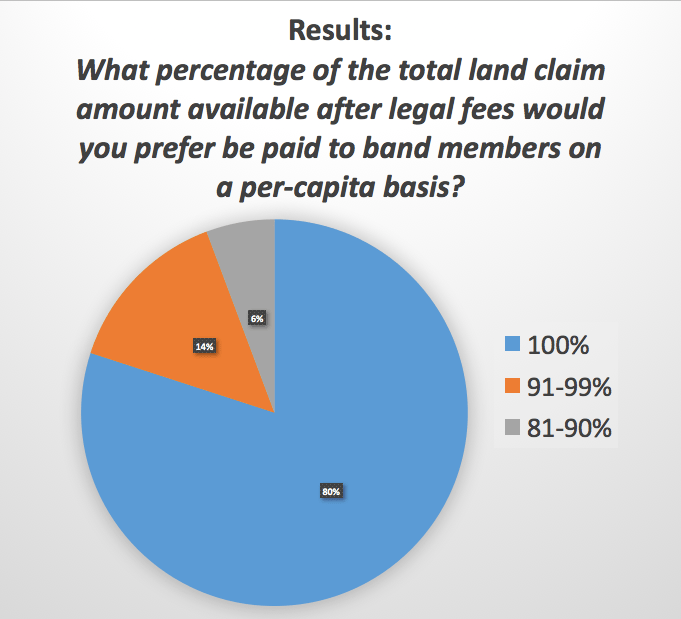
The vast majority of survey respondents felt that a 100% per capita pay-out to FWFN members is in order.

In response to the question, What percentage of the total land claim amount available after legal fees would you prefer be paid to band members on a per-capita basis?, respondents noted the following:

Answer Choice Responses Per cent of Respondents
100% 56 80%
91-99% 10 14%
81-90% 4 6%
71-80% 0 0%
61-70% 0 0%
51-60% 0 0%
41-50% 0 0%
31-40% 0 0%
21-30% 0 0%
11-20% 0 0%
0-10% 0 0%
70 100%

Screen Shot 2016-07-26 at 9.28.37 AM


Notes
The member-led Grand Trunk Pacific Settlement Survey received 71 responses between July 1 – 25, 2016. All respondents except one provided their name for verification – the unnamed person’s survey responses are not included in the Survey Results. This survey was made available online through Survey Monkey, and was advertised within Fort William First Nation via various closed FWFN-specific Facebook groups. The survey was closed at 11:59 pm on July 25, 2016. Respondents were limited to one response per person. Respondents’ names are not shared in order to protect their privacy.

Getting over the Status Hangover: #LetJosiahPlay

I have been watching with excitement over the past few days the story of Josiah Wilson – a Heiltsuk man who has been refused entry into northern British Columbia’s All Native Basketball Tournament because he does not meet a minimum blood quantum requirement.  Josiah is black, born in Haiti, and adopted into the Heiltsuk nation by his father, Don Wilson.

The media attention given to Josiah’s story is a good thing.  It is raising important questions about how Indigeneity in Canada is defined, by whom, and about whether adoption is valid grounds for Indigenous peoples to claim individuals as citizens of their nations.

However, while Josiah’s story seems to be challenging many of us to wrap our heads around inherent Heiltsuk law, it also presents us with another ‘teachable moment’: in each story I’ve read so far, the role of Indian status seems to emerge as the “real” proof that Josiah belongs as Heiltsuk.  This is ironic and potentially damaging.

Adoption stories provide us with an opportunity to think about inherent Indigenous citizenship orders on their own terms in two important ways.  First, they show us that such orders are not heterosexist in nature.  Blood quantum, after all, is a heterosexist concept: it demands that Indianness be reproduced exclusively through heterosexual parenting.  Adoption stories, therefore, show us that Indigenous citizenship orders include queer families in renewing Indigenous nations.

Second, adoption stories show us that families are the decision makers within inherent Indigenous citizenship orders.  Unlike under the Indian Act, where belonging is determined by the Indian band in a centralized manner, adoption stories show us that families decide who belongs in a decentralized sense.  This is important because it helps us to see that the authority to discern citizenship flows from Indigenous peoples’ own constitutional orders, not the Indian Act.  All of this is reflected in how Josiah’s family and community claim him in the media: he is a Heiltsuk citizen regardless of bloodline because he was adopted by a Heiltsuk family.  His father made this perfectly clear: “[Our children are] ours. We as the Heiltsuk Nation accept my son as one of us.”

Yet, in each story I’ve read over the past few days, Josiah’s “status card” slips into the discussion seemingly as a sort of authenticator.  While his status as an Indian under the Indian Act is an important fact, I worry that it is being used as the ultimate proof of Josiah’s belonging.  Its as if Heiltsuk citizenship law is not enough.

On one hand, including Josiah’s Indian status in this story is understandable.  Collectively, we are suffering from “status hangover” given that, for generations, Canada made membership in an Indian band based solely on Indian status.  Put simply, many now see Indian status as a pre-requisite to being Indigenous.

However, the over-emphasis of Josiah’s Indian status in the discussions about him being and belonging with Heiltsuk runs the risk of hiding the most important element of this story, namely, that Indigenous citizenship laws are alive and well.  Such laws do not need the recognition of Canada to be valid.

Ultimately, it is up to Indigneous nations themselves to determine who belongs with them.  As Josiah’s story clearly attests, Heiltsuk citizenship law has survived the assertion of Canadian sovereignty.  This needs to be emphasized not only because its clearly the source of law that claimed Josiah as Heiltsuk, but ultimately because it demonstrates that Indigenous peoples throughout Canada do not need to rely on Canadian laws to determine who belongs.

With this in mind, the pathway forward can be one of demanding Canada base resource allocations in accordance with Indigenous citizenship orders rather than the terminal concept of Indian status.

Reconciliatory Education: Mandatory Unsettlement

Today, the discussion about reconciliation reached a crescendo in Ottawa. There, the Truth and Reconciliation Commission released its final report detailing its findings from over six years of working with thousands of survivors of Canada’s Indian residential schools system.  But now the challenge for Canada and Canadians will be to avoid interpreting reconciliation in ways that don’t re-colonize Indigenous peoples. It may therefore be worth paying attention to how reconciliation is being defined, and how some are already planning to use it in the education system.

For its part, the TRC defines reconciliation in terms of action. It is the active rejection of “paternalistic and racist foundations” as the basis for an ongoing relationship between Indigenous nations and Canada. It has called for reconciliation to be a “new vision” based on a commitment to mutual respect. This new vision could be reached, notes the TRC, by mandating “education for reconciliation” in Canadian schools where students learn more about Indigenous peoples.

For others, reconciliation is the continuation of struggle. In a brilliant piece in The Globe and Mail, Hayden King and Erica Violet Lee note that reconciliation might best be understood as an on-going “conflict” where Indigenous peoples will demand the return of men, women, children, knowledge and land, and Canada will keep refusing. This approach inherently challenges a mode of reconciliation predicated on ‘turning the page of history’ – reclaiming is not about forgetting.

Elsewhere, Billy-Ray Belcourt writes that reconciliation is a “contradictory object.” Apropos: “[reconciliation] only wants to collect the good public emotions it needs to keep going, to push itself outside of History, to narrate a present bereft of legislated pain.”

To me, this framing is reminiscent of how s.35 of the Canadian Constitution has been “interpreted” to the benefit of the state. Likewise, there is a real risk that reconciliation could be used to solidify Canada’s control over Indigenous peoples; all that is needed is for the term to be interpreted in ways that do not challenge Canada’s settler colonial foundation. As Belcourt rightly observes, therefore, “a world reconciled is not necessarily a world decolonized.”

Tracing the definition of reconciliation over the coming months will be an on-going project, and one that will require Indigenous peoples’ voices pushing back against those who would like to define it in ways that reaffirm Canadian paternalism. Tracing this debate might become increasingly confusing. But one place where the tension over the definition of what reconciliation could mean is already evident is in how some universities are approaching mandatory Indigenous education.

Much has been said about making Indigenous studies courses mandatory at Canadian universities in recent months. In February of this year, Lakehead University announced that starting September 2016, all undergraduate students at that university will be required to take a course with Indigenous content. In November, the University of Winnipeg announced that it would be following suit.

But content and politics matter.

In an article published in The Globe and Mail on December 20th, 2015, Annette Trimbee and Wab Kinew write that the University of Winnipeg will provide undergraduates with a list of approved courses from which they can choose their mandatory Indigenous course. Students will select a course that “aligns with their degree program or one that piques their intellectual curiosity.” This is in keeping with the approach that Lakehead University is taking as well; for Trimbee and Kinew, this means that, for example, “business students will learn how to engage with indigenous communities,” thereby giving University of Winnipeg students a “competitive advantage.”

Thus, based on what I’ve read so far, both Lakehead University and the University of Winnipeg’s definition of reconciliation could be summed up  as “learning more about Indians.” Despite my open criticisms to this approach, I’ve not seen a statement by either university noting that said mandatory courses will actually challenge students’ complicity with settler colonialism and white supremacy.

As you might guess, I see this orientation as problematic. It is worth noting that the “learning about the other” approach has historically been used as a tool of colonialism around the world, in which Indigenous nations’ claims to their own lands have been “interpreted” in ways that justify the occupation of a dominating, foreign power. Given this, one could ask: Whose interests are centered when mandatory Indigenous education is defined as learning about “the other” rather than learning about how Canada remains a colonizer in the present?

I therefore wonder how useful it will be to Indigenous nations when students come knocking on their doors having taken a half-credit course about Indigenous culture(s) without also equipping these same students with an understanding about how their approaches might perpetuate a relationship where Canada justifies its regulation of Indigenous peoples, and their political and legal systems. Is this reconciliation? If it is, we have a problem. To paraphrase Billy-Ray Belcourt: a university reconciled will not necessarily be a university decolonized.

For mandatory Indigenous education to be actually reconciliatory in this historical moment, therefore, it must flip the lens and unsettle students’ complicities with settler colonialism, and it must do this in addition to teaching about Indigenous issues.

Only then can Canadians start finding concrete ways to give land back to Indigenous nations, which, to me, is the minimum starting point for what reconciliation should really be about.

Speaking Notes: Disrupting Safe Spaces 4 Racism in Thunder Bay

Waverley Library
Thunder Bay, ON
October 8, 2015
Twitter: @damienlee

Download the accompanying PowerPoint slides, here.

As many of you will recall, the James Street Swing Bridge burned the night of October 29, 2013.  This fire sparked off a very public dialogue about racism: news reports were generated,[1] public speaking events were held,[2] and high school classrooms took the opportunity to define what racism looks like in real and immediate terms.[3]  While racism no doubt existed in Thunder Bay before that night, the burning of the bridge was a watershed moment in our collective anti-racism discussions, not least of which because it forced the issue of racism out from under the bed and into the limelight.  Anti-Indigenous racism in Thunder Bay could not be ignored, no matter how people wanted to write it off.  While the politicians looked for the culprit or culprits responsible for the arson, social media was on fire with racist slurs meant to do one thing: to remind Anishinaabeg that they are not safe in Anishinaabe Aki, or the Ojibwe Homeland.

It is the element of safety in anti-racism discourse that I want to focus on today.  What made October 29th “watershed,” is not just the fact that the racism expressed was so extreme, nor just the fact that Thunder Bay and Fort William First Nation still have not fully recovered from it.  Rather, it was also that the burning of the bridge forced white people to see the type of violence Indigenous peoples in Thunder Bay face each day.  Even if invisible to others, it showed that Thunder Bay is not safe for Indigenous peoples precisely because they are told, in varying ways, that their presence here is at best, tolerated, and at worst targeted for removal.  In short, “safety” was revealed to be a tenuous concept, as it was so swiftly taken away by those who wanted to punish Fort William First Nation for just being an Indigenous community.

Read More

Dolezal vs. Smith: Apples to Oranges?

As I sit down to write this, my social media feeds are rumbling with commentary on the links between Rachel Dolezal’s claims to being black, and Andrea Smith’s past claims to being Cherokee.  I’ve read over the past days several postings on this issue, including blogs written by Lynn Gehl, Dina Gilio-Whitaker, Erica Violet Lee, and one on the tequilasovereign blog.  I suppose the comparison between Smith and Dolezal was inevitable in the Indigenous studies community, where identity construction is a huge issue, and where fraudulent claims to being Indigenous is an even a bigger issue.  And rightfully so; as Erica pointed out this morning, there are too many white settler folks taking space and air-time away from Indigenous peoples and Indigenous women in particular.

It is because of this latter point that I have not added my two cents into the discussion about how Dolezal’s claims reverberate through Indigenous communities.  I have zero per cent Indian blood.  I’m phenotypically white.  Cis male.  And straight.  I mean, its nearly impossible for anyone to have less authority in this matter, at least in an ethical and decolonizing sense.

That said, I share this post now as someone who, despite my whiteness, my maleness, my heteroness, is also a citizen of the Anishinaabe nation through customary adoption.  I was adopted into Fort William First Nation as a toddler, two years before my white biological mother “married in” to the community.  Despite all of the above, I identify as Anishinaabe, and I am claimed as such by my community.  But as Tuck and Yang point out, my adoption should not be seen as a move to innocence: I am not so clueless as to think my adoption in and of itself destroys white supremacy, my whiteness (including how my thinking has been produced), or colonialism, nor does it absolve me from undermining whiteness and patriarchy in every single way that I can.  I share so much of my positionality because its important for you to know where I’m coming from – so that you can decide for yourself if what I’m about to say holds any water…

What I’ve found most interesting in the discussions about what implications Dolezal’s claims might have for Indigenous communities, is that Andrea Smith’s past claims to being Cherokee have come up at all.  In some ways it makes common sense to juxtapose Dolezal to Smith: both had made identity claims that were challenged and, to different degrees, retracted.  In this common sense approach, Smith’s story has become the lightning rod upon which we in the Indigenous studies community attempt to understand Dolezal’s story.

But by finding resonance for Dolezal’s story in this way, I wonder if we’re missing a nuanced point.  And that is: are we not conflating racialized identity with Indigenous citizenships?

My worry is that defaulting to comparing Smith to Dolezal demonstrates how much Indigenous identities have been racialized, and, more importantly, how we might be upholding such racialization.  The fact that Smith’s claims to Indigeneity have to somehow automatically be compared to Dolezal’s claims to blackness seems to betray something that many people are thinking but not saying, namely: that Indigeneity is always-only a race thing.  While there is no doubt that the Indigenous peoples are racialized as “Indians,” I don’t think Smith claimed to be a different race; she claimed to be Cherokee, which under many (though not all) Indigneous citizenship systems would be totally ok so long as the community/nation one is claiming to belong with claims her/him back.

I don’t know Andrea Smith personally.  So I cannot answer any of the questions currently swirling through the blogosphere about her original claims to being Cherokee (see blog links above), nor would I want to police her identity in any way.   But many brilliant scholars have pointed out that to belong with an Indigenous nation is not only a matter of biological descent.  Family-making practices renew a nation’s citizens in several ways, including through birth, but also through marriage and adoption (Don Auger-ba provides a good example of adoption and belonging, here).

In trying to understand Andrea Smith’s story, I can only draw on my own experience of being Anishinaabe through customary adoption.  And one of the key things I’ve learned is that the public at large often refuses to consider the possibility that one can belong with an Indigenous nation without some high quantum of Indian blood.  In other words, Indigeneity is racialized in the common sense.  Lost in this way of thinking are the Indigenous citizenship laws that operate on their own frequencies, often doing so with different ideas about what constitutes essentialized identity, which in turn often operate in ways beyond a narrow focus on blood line.  What often matters more, is whether a person is claimed by an Indigneous community/nation, whether they identify with that nation, and how they carry out their responsibilities to family, nation and land.

I believe that, as scholars, it is incumbent upon us to extricate our own blind spots in discussions meant to be decolonizing.  In the current discussions about Dolezal, it is important to be aware of how that story is one of whiteness appropriating racialized identity for its own goals, and how this differs from the issue and function of Indigenous citizenships.

On this note, I would argue that Erica has posed the most important question yet in the current Andrea Smith discussion.  She asks, “Will Andrea Smith be claimed by an Indigenous community (in whatever form that takes) in the days or years to come? Would it even make a difference now?” [Emphasis mine]  Indeed, would the Indigenous studies community be willing to see belonging beyond race if the Cherokee nation reached out to Andrea and claimed her as Cherokee?  Or would such claiming of a person, and the Indigenous citizenship order it would rest on, be obfuscated by the same racializing principles that cause us to automatically compare Smith to Dolezal?

Cindy Gladue: Aren’t We All Women?

Guest post by Jana-Rae Yerxa

How come we never have to think of ways to humanize whiteness?

I arrived at this question after not being able to sleep last night. Cindy Gladue is on my mind. She is in my thoughts. She is in my prayers. She is now in my heart.

I am filled with so many emotions. I am enraged by the fact that there is no justice for her. Enraged that Bradley Barton claims he did not murder Cindy and that she consented to rough sex with her alcohol level four times past the legal limit. Enraged because his peers believed him and declared he was not responsible for Cindy’s death. He is free while Cindy is dead. I am enraged, disgusted and saddened not only because the Canadian legal system failed tremendously in obtaining justice for Cindy, which I am not surprised by, but also in the way the system violated Cindy again by treating her body in such an undignified manner- preserving her pelvis as evidence to debate whether the 11cm wound to her vagina was consensual.

The lack of regard by the Canadian legal system’s handling of Cindy’s body signifies that even in death the grips of settler colonialism and the stigma and discrimination against women who work in the sex trade would not let go demanding further dehumanization of Cindy during the trial. Dehumanization of this Indigenous woman, of Cindy, placing her intimate body parts on display for debate as if she and her body were on on trial. I am saddened for her and her family. I am also saddened and scared for the rest of us as a society if we do not stand up against this injustice and dehumanization.

I am reminded of Patricia Monture’s truth telling words and how relevant they are for all of us at this time: “If rape occurs, if battering occurs, if any form of violence is present, all women are harmed and live with the knowledge that each of us is a potential victim.”

It is at this point where I again become angry and realize yet again that society at large did not see Cindy as human. Her indigeneity and her involvement in the sex trade do  not erase Cindy’s humanity despite attempts to do so by the structures of settler colonialism and its good friends- whiteness and heteropatriarchy.

It is also at this point where I feel compelled to list off all the reasons why Cindy is human. Her life mattered. She deserves justice. She was a woman. She was a mother. She was a daughter. She was a sister. She had a family that loved her and that she loved back. She had hopes. She had dreams. She was Indigenous. She was a sex worker.

Why do we always have to think about how to humanize non white humans? And how come we never have to think of ways to humanize whiteness when it behaves so inhumanely?

Rest in peace Cindy Gladue.

Jana-Rae Yerxa is Anishinaaabe Kwe from Couchiching First Nation located in Treaty 3 Territory. She is a graduate of the Indigenous Governance program at the University of Victoria. She can be found on Twitter: @janaraey

If I were Chief 

On Saturday, February 28, 2015, I was nominated for chief of my community, Fort William First Nation. 

If I were chief, this is what I would do:

1. I’d donate my seat to the Elders Council.  Meaning: I would develop a strategic two year plan with the Elders, then operationalize it from the chief’s seat. My words would be based on their vision. 

2. I’d donate 100% of my monthly honorarium to the Elders Council so they would have money to meet and make the decisions that give me direction (see point 1 above)

3. I would engage a critical education campaign that focuses on empowering our citizens with the tools they need to challenge the racism and colonialism that keeps them/us in poverty. 

4. Finally, I’d move all band council meetings out of the council chambers and into a less violent space, such as the community centre or youth center (with permission of those who use those spaces already, of course). 

Thats it.

Indian in a Jar?

Yesterday, Lakehead University announced that starting in 2016, all LU undergraduate students will be required to learn (something) about Indigenous peoples.  As reported by CBC Thunder Bay, this initiative is meant to ensure LU graduates have exposure to “significant indigenous [sic] knowledge,” and to develop basic understandings of treaties, and racism, among other issues.  The program is also meant to be flexible: exposure to Indigenous issues will be tailored to particular areas of study.  LU prides itself on being a school of and for the north, and so this programming could prepare non-Indigenous graduates for working in a northern Ontario reality, where Indigenous politics are enmeshed in everything.

In hearing this news, I was reminded immediately about something that happened in the Fort William First Nation sugar bush a few months ago.  I want to tell you about what happened there because it provides a backdrop against which I can assess yesterday’s announcement.

Settler Colonialism in the Sugar Bush

In the fall, my colleague – Gail Bannon – and I met with several Lakehead University students and their instructor in the sugar bush.  Several of us at FWFN have been working hard to revitalize our connection to inaantigag; after nearly three decades of not visiting, the bush is in need of some management to make it safer (identifying dead or near-dead trees that should be removed) and to optimize sap production for future generations.  We don’t necessarily have this knowledge “in-house,” so we did like any good Anishinaabeg would and reached out to those who had it – in this case, students from a department at Lakehead University.

But something happened that day that I think none of us have forgotten. Boundaries were broken, trust was put into question, and the colonialist sense of entitlement to Indigenous lands reared its head.

After not finding the students and instructor at the location we agreed to meet at, Gail and I decided to look for them in the sugar bush.  This is how our initial face-to-face meeting unfolded:

Me: Hi everyone.

Instructor: Hi there! How are you?

Me: Surprised. I’m surprised that you didn’t wait for us at the location we agreed to.

Instructor: Oh. I’m sorry, we must have get the meeting time wrong. So we just came up to look around and get started.

Me: The reason I’m surprised is that this place is important and sacred to us. Its not a place in which we want people poking around without a proper introduction, both to its history and connection to our community, but also to the trees themselves. You coming up here as you did today is representative of how colonialism works in the academy: you see yourselves as having a right to access Indigenous lands without representatives of Indigenous communities present.

Awkward silence.

Instructor: Is that something you work with? Colonialism?

Me: Colonialism is what my PhD studies are focused on ending, in one way or another. And one of the ways to end it is to establish good relationships with each other. Its about protocol. We invited you here because we want to establish a relationship with you and Lakehead University, because you have something we need. But we can’t do that without having a protocol in place.

Instructor: Oh, my apologies (he was sincere). I think developing a protocol is something we should do in phase two of this relationship.

Me: No. Establishing protocol and good relations comes before anything else. Nothing can happen here without it.

More was said, but we eventually got to the work that we had wanted to do that day.  And I am happy to report that our relationship with the students from the department at Lakehead University turned out well, with a very useful report being produced and given to us, and the relationship continues to unfold in positive ways.  But my point in telling this story is that regardless of our visitor’s intensions, what happened that day suggested to me that they had not been made aware by LU about how settler colonialism could work through them.  I think part of their surprise was a realization, however partial, that they could be (and were being) unwitting tools in upholding and expanding settler colonialism’s knowing of the Other.

Flipping the Lens

Earlier today, when I heard about Lakehead’s announcement, I wondered: If LU had instituted a mandatory Indigenous exposure policy, say, a decade ago, would it have changed what happened in the sugar bush that day last fall?  Maybe.  It might have, for example, made the students and instructor aware that the sugar bush is a sacred site, and that protocol is important. Maybe they would have waited for us at the agreed location.

But then I am also careful about projects that aim to learn more about the Other without substantive self-reflection being a core part of the process (and here I am talking about the Lakehead’s announcement). I believe that simply learning about Indigenous peoples isn’t enough to end colonial violence. This is because Canada and Thunder Bay are structured by settler colonialism and white supremacy. In this context, learning about Indigenous peoples is easy because it doesn’t question positions of power.

It is from this position, therefore – one of turning the lens back onto settlers in a settler colonial context – that I want to assess Lakehead’s news.

Indian in a Jar

My favourite piece of writing of 2014 was produced by my friend and fellow Anishinaabe scholar, Jana-Rae Yerxa.  Her powerful article, entitled Refuse to Live Quietly!, calls out so-called anti-colonial initiatives that can actually reproduce or protect colonialism in spaces of higher learning.  She writes:

I am tired of the ‘safe’ strategy that focuses on educating settler folks about an ‘Aboriginal experience,’ about ‘Aboriginal people’ and ‘Aboriginal history,’ instead of settler colonialism, white supremacy, and settler colonial violence.  I am tired of this safe strategy because it is not safe for me as an Anishinaabe Kwe. It is safe for settlers.  This is wrong because this type of educational approach is not only ineffective, it is also harmful.  It presents a guise of meaningful work, when the work needed – dismantling settler colonialism and ending settler colonial violence – is not actually being done.

This is an important critique to consider when assessing an initiative meant to expose all Lakehead University undergrads to Indigenous issues and knowledges on a mandatory basis.  Jana’s work here forces us to ask: Who’s comfort is being centered in such an initiative?

I have to admit at this point that I have not seen the project outline for what I am calling the Indigenous issues exposure initiative. All I have to work with here is the CBC Thunder Bay news article posted yesterday. But based on that, I question who’s comfort is being taken care of. For example, the article states that the teaching on Indigenous peoples/issues will be “tailored to each student.” My colleague representing the Office of Aboriginal Initiatives – Yolanda Wanakamik – explains that this tailoring might take the shape of foresters learning about treaties, or engineers destined for work in the north learning about “the culture of First Nations.”

However, as Jana’s work would suggest, this approach is safe for settlers. It allows settler undergraduate students to chose aspects of Indigenous peoples, issues, cultures, etc., that do not challenge their comfort zones. For example, learning about Indigenous “culture” in Canada is safe because it is often done through a framework of multiculturalism, where non-European worldviews, practices, art, laws and governance systems are decontextualized as “culture” that can be “tolerated.”  Looking at the Other in this way is different from learning about the “cannibal culture” of settler colonialism because settlers’ emotional, political, psychic and physical safety are given priority. Settler undergrads might therefore learn about treaties and culture, but this does not demand they undermine their own complicity in a settler colonial system that privileges straightness, whiteness, maleness, able-ness.

Tailoring Indigenous issues rather than turning the lens towards one’s complicity with settler colonialism presents a fractured picture.  In this critique, fracturing Indigenous realities into safe pieces of information commodifies lived Indigenous experiences of violence.  It renders these experiences, and Indigenous peoples’ resistances to them, into innocuous substances easily preserved like condiments that settlers can chose from as they walk down grocery store aisles thinking about what they want to digest on a given day. Lakehead University should avoid this “Indian in a jar” approach if it is serious about ending the foundational causes of colonial violence felt by Indigenous peoples.

Mandatory Indigenist Education

By contrast, what if exposure to Indigenous issues at LU took the shape of mandatory Indigenist education? Like Lakehead’s approach above, Indigenist theory centres Indigenous peoples’ worldviews, and the knowledges held by Indigenous women, children and the land. But it goes further: it is also consciously anti-colonial, and challenges the academy’s monopoly on what counts as knowledge. Importantly, because it is decidedly anti-colonial, it opens space for settler students to critically engage with their complicity with settler colonialism.

Key to achieving this would be a mandatory course (or more) focusing on the resurgences of Indigenous peoples worldviews and political orders. In these spaces, projects could depend on each student’s positionality: Indigenous students could focus on the resurgences of Indigenous laws, whereas settler students could complete projects concerned with ways in which settler colonialism has created the need for the resurgence of those same Indigenous laws.

Central to developing a mandatory anti-colonial course for all Lakehead undergrads – and one that does not commodify Indigenous struggles – would be ensuring students understand that just because racism and colonialism are being talked about does not mean the space is safe for everyone.  No doubt, this would be a process of unsettlement; much like what happened in my story about the sugar bush above, these unsettlements would create “teachable moments” where light is shone on the real problem of (un)knowingly upholding settler colonialism.  White students, for example, will be expected to embrace feelings of discomfort for having their colonial complicities discussed; such discomfort is integral to anti-racist/anti-colonial learning environments because it “promote[s] an honest dialogue about the need for the state and settlers to make amends to Indigenous peoples today,” as noted by Corntassel.

The great thing is, there are already university courses being offered that do just this. Lakehead’s own Department of Indigenous Learning offers INDI 2805 – Native Canadian World Views.  The University of Victoria’s Indigenous Governance program offers IGOV 520 – Indigenous Governance, among other relevant courses. If LU is serious about sending graduates into the world capable of ending colonial violence, then why not make courses like INDI 2805 and IGOV 520 mandatory for all students?

Full Circle

In reflecting on the above, I return to what happened in the sugar bush.  Had LU instituted an Indigenous learning initiative that required settler students to examine their own complicity with settler colonialism, I feel more confident in saying the students we met that day would have been aware of the power they had as young, white, male scholars; maybe they would have been more willing to undermine that power, and to allow us to introduce them properly to that piece of land. I think they would have been more ready to engage proper protocol.  And so, if Lakehead University wants to make things better for Indigenous peoples, it can play a key role by informing the majority of its students how to not reproduce the settler colonial power they have been given by a system no one tells them about.

Amendment: A previous version of this post included the name of the LU department mentioned in the section discussing the sugar bush above. The name was removed after a representative of said department contacted me with a request to protect its faculty.